
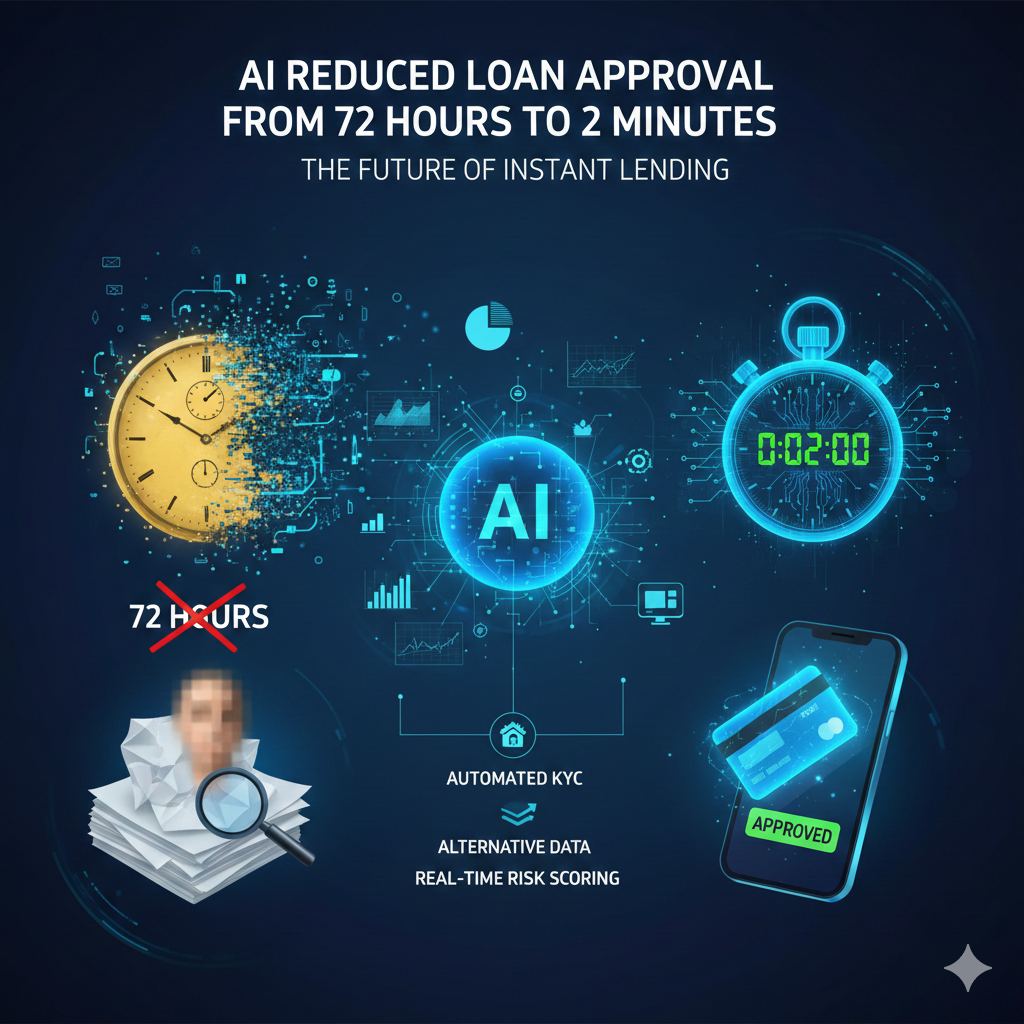
AI Reduced Loan Approval from 72 Hours to 2 Minutes: A Deep Dive Into the Future of Instant Lending
The lending industry has undergone a massive transformation in the last few years. What once required manual verification, branch visits, paperwork, and 72+ hours of approval time has now been compressed into a lightning-fast, fully automated 2-minute loan approval journey—powered entirely by AI, automated KYC, alternative data models, and real-time risk scoring.
This blog explores how fintech companies achieved this breakthrough, the technology stack, real-world use cases, KPIs, and the future of AI-driven credit decisioning.
⭐ Introduction: The Evolution of Digital Lending
Before AI entered the lending ecosystem, banks and NBFCs relied on manual assessment, physical documents, human-driven verification, and long underwriting cycles. Customers disliked the waiting period while lenders struggled with operational inefficiencies.
Enter AI-powered digital lending.
Today, most fintech lenders in India and across the world leverage:
- Artificial Intelligence
- Machine Learning (ML)
- Video & Digital KYC
- OCR and Document Parsing
- Behavioural & Alternative Data
- Real-Time Identity Verification
- Automated Rule Engines
- Instant Credit Risk Scoring
These technologies combine to create a lending journey that is fast, data-driven, accurate, and scalable.
⭐ How AI Brought Loan Approval Time Down From 72 Hours to 2 Minutes
AI optimizes the lending flow in four major stages:
- Instant Identity Verification (KYC)
- Automated Document Analysis
- AI/ML Credit Risk Scoring
- Real-Time Loan Decisioning
Let’s explore each stage in detail.
1. Automated KYC: From Manual Checks to 30-Second Verification
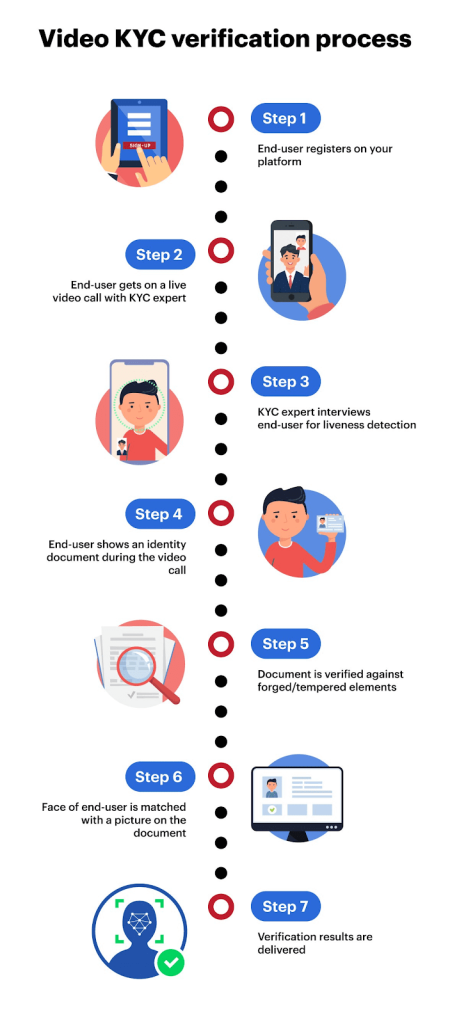
Manual KYC traditionally involved:
- Branch visits
- Human validation
- Multiple documents
- Risk of fraud
AI transforms this experience using:
✅ Video KYC
Liveness detection, facial recognition, and digital signatures confirm identity.
✅ OCR & Document Parsing
AI extracts name, DOB, address, Aadhaar details, and PAN numbers in seconds.
✅ Fraud Prevention
The system uses global databases, watchlists, and pattern recognition to prevent identity fraud.
Time saved:
Manual = 24–48 hours
AI KYC = 10–30 seconds
2. AI-Driven Document Verification & Income Assessment
AI eliminates the need for manual document review using:
- OCR for bank statements
- Categorization of income vs expenses
- Salary slip extraction
- GST return data
- ITR-based income recognition
- Employment history validation
Outcome: Faster and more accurate income assessment.
3. Risk Scoring Models That Replace Traditional Credit Scores
Traditional credit scores (CIBIL, Experian) provide a limited picture.
AI expands this by analyzing over 500+ data points, including:
📌 Alternative Data Inputs:
- Mobile usage pattern
- App installation profile
- SMS financial data
- E-commerce behaviour
- UPI transaction history
- Repayment behaviour with other lenders
- Geolocation stability
- Device fingerprinting
📌 Machine Learning Models Used:
- Logistic Regression
- Random Forest
- Gradient Boosting
- Deep Learning
- Ensemble Scoring Mechanisms
These models allow lenders to approve borrowers—even thin-file or new-to-credit customers—with high confidence.
4. Real-Time Decision Engine (2 Minutes or Less)
A rule engine + ML model takes all the data points and decides:
- Loan eligibility
- Maximum loan amount
- Tenure
- Interest rate
- Fraud signals
- Risk category
This happens instantly on the backend, while the end user sees an approval within seconds.
Time saved:
Traditional underwriting = 72 hours
AI-powered underwriting = 2 minutes
⭐ Comparison Table: Traditional Lending vs AI-Driven Instant Lending
| Process Step | Traditional Lending (Manual) | AI-Driven Instant Lending | Time Saving |
| KYC Verification | Physical docs, branch visits | Automated Video KYC, OCR | 48 hrs → 30 sec |
| Document Review | Manual verification | AI document parsing | 24 hrs → 20 sec |
| Credit Scoring | Based on CIBIL | AI assesses 500+ data points | 12 hrs → Instant |
| Fraud Checks | Limited, manual | Real-time pattern detection | Hours → Instant |
| Loan Decision | Human underwriter | Automated rule engine | 24 hrs → 10 sec |
| Disbursement | Batch processing | API-based instant disbursement | 4 hrs → 30 sec |
Total Time:
Traditional = 72+ hours
AI-Powered = 2 minutes
⭐ The Tech Stack Behind the 2-Minute Loan Approval
Below is a detailed breakdown of the modern fintech tech stack:
1. Frontend Layer (User Onboarding)
- Mobile app / web app
- Loan eligibility form
- Document upload module
- KYC module
- Consent collection
Technologies: React, Next.js, Flutter, Swift
2. Identity Verification Layer
- Aadhaar XML / eKYC
- Video KYC
- Biometric verification
- Face match API
- Fraud detection API
Popular providers:
Signzy, Hyperverge, Au10tix, FRS Face Recognition
3. Data Aggregation & Parsing Layer
- Bank statement analyzer (Perfios, Karza)
- GST & ITR APIs
- PAN verification
- UPI transaction insights
- SMS data parser
4. AI/ML Risk Engine
Core features:
- Probability of Default (PD)
- Debt-to-Income Ratio (DTI)
- Behavioural scoring
- Social scoring
- Employment stability
- Fraud probability
ML Tools:
- Python
- TensorFlow
- PyTorch
- Scikit-Learn
- Gradient boosting frameworks (XGBoost, LightGBM)
5. Decision Engine
Decision-making rules include:
- Income thresholds
- Age limits
- Geolocation risk
- Existing liabilities
- Borrower behaviour
Once AI approves, loan terms are auto-generated.
6. Disbursement Layer
- Bank-to-bank IMPS/NEFT APIs
- UPI autopay setup
- eMandate (NACH / eNACH)
- Loan agreement e-signing
Platforms: RazorpayX, PayU, Cashfree, M2P, Decentro
Result: Money reaches customer account within seconds.
⭐ Case Study: How One Fintech Reduced Approval Time to 2 Minutes
A leading Indian fintech lender implemented an AI-first lending model in 2024.
Before AI, their loan approval time was:
- Average: 72 hours
- Rejection rate: 35% (mostly due to incomplete documents)
- Operational cost per loan: ₹110
After implementing AI:
📌 KPIs (Before vs After)
| Metric | Before AI | After AI | Improvement |
| Loan Approval Time | 72 hrs | 2 min | 99% faster |
| Customer Drop-Off Rate | 60% | 18% | 70% lower |
| Cost per Loan | ₹110 | ₹22 | 80% lower |
| Fraud Cases | 4.5% | 1.2% | 73% reduction |
| Loan Approval Rate | 65% | 82% | 26% increase |
This proves how AI transforms lending efficiency, safety, and profitability.
⭐ Benefits of AI-Driven Instant Loan Approval
1. Faster Customer Onboarding
Users can apply, upload documents, and get approval in minutes.
2. Higher Accuracy
AI eliminates human errors and bias.
3. Lower Operational Costs
Banks and NBFCs can scale without increasing staff.
4. Fraud Reduction
Machine learning identifies abnormal patterns instantly.
5. Improved Financial Inclusion
People with low credit history also get loans.
6. Higher Customer Satisfaction
Fast loan disbursal enhances user trust and retention.
⭐ Challenges in AI-Based Lending (and How Fintech Solves Them)
1. Data Privacy Concerns
Solution: End-to-end encryption, tokenization, consent-based access.
2. Model Bias
Solution: Fairness testing, bias detection layers, human oversight.
3. Regulatory Complications
Solution: RBI-compliant digital lending norms, transparent disclosures.
4. Model Drift
Solution: Continuous model retraining to stay updated.
5. System Integration
Solution: Modular microservices architecture with secure APIs.
⭐ The Future of AI in Lending (2025–2030)

The next evolution of instant lending will focus on:
🔹 1. Predictive Lending
AI will predict when users need money before they apply.
🔹 2. Hyper-Personalized Loan Offers
Customized interest rates based on real-time behaviour.
🔹 3. 10-Second Loan Approval
AI models are expected to shrink the 2-minute process further.
🔹 4. Blockchain-Based KYC
Decentralized identity verification for global lending.
🔹 5. GenAI in Underwriting
AI agents performing end-to-end underwriting.
🔹 6. Zero Human Involvement Lending
Full automation from onboarding → approval → disbursement.